Life with an almost-three year old and a soon-to-be-one year old is exhausting. Life as a first grade teacher can be pretty arduous as well. However, living life with all these little people has taught me a lot about perspective and has challenged me to remember how frequently I am wrong…and how great being wrong can be.
A few weeks ago, I gave my students a math task, and as they set to work, I reminded them to: “Show your thinking.” We have been practicing this for weeks: I have modeled how to “show your thinking” through equations, simple math drawings, etc. and my students have had many opportunities to practice these skills as well. However, my students are still six and seven year olds sitting with white boards in their hands, and the temptation to use this time for “free choice” drawing is often still more than they can bear.

This particular day, I happened to notice a student drawing a self-portrait on her white board rather than settling in to the task at hand. I approached her and attempted to redirect her with a simple: “Remember, we are doing our math work now.” She briefly met my eyes with a somewhat questioning expression and then silently got back to work on her drawing. I could feel my frustration rise as I tried again: “It isn’t time to be drawing pictures now. We are doing our math work.” She looked up again, and this time she audibly questioned me: “But teacher; you said to show your thinking?” I was ready with a standard, “Yes, and we need to be doing that right now. Where is your equation?” but as I opened with a, “Yes…” I caught myself, and quickly fell silent, as I actually took the time to see what she had been drawing on her board. There on her self-portrait, she had erased the spot where her white board hair had once been, and she was busy writing in just exactly what she was thinking. While I had been busy reminding her to show her thinking, that’s exactly what she had been trying to do. Granted, she wasn’t using one of the methods we had practiced, but she was, in the most literal way possible, illustrating for me just exactly what her thinking “looked” like. I managed to acknowledge her thinking, and hopefully validate it too, before giving the whole class a reminder as to what, “Show your thinking,” means in our classroom.
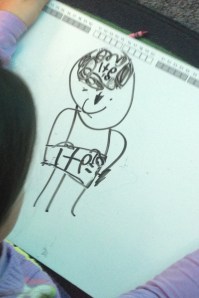
I’m grateful for moments like that with my students. Sometimes it is good to be reminded of just how wrong I can be; even when I’m certain that I’m “right.” I think that’s the power of perception: sometimes I take comfort in knowing that my perception of any situation doesn’t tell the whole story.
The year after Patrick and I were married, we both worked long days, and we often didn’t see each other until late at night. After one particularly long December day, we decided that we were going to set aside our exhaustion and decorate a Christmas tree. Though we didn’t have much money to spend on our decorating endeavor, we were determined as we set out in search of the “perfect” tree. We ended up at the only store still open, and we bought the cheapest tree we could find: a $20 artificial tree from Wal-Mart. Needless to say, this was no winsome pine; and from the beginning we made fun of our silly, bargain tree. But as we assembled and decorated our tree, it made our first apartment feel even more like a home as we celebrated our first Christmas together. When our second Christmas rolled around, we decided that we needed to keep our silly tree another year. But as we decorated; we dreamed about, and planned for, the grand tree we would one day afford.
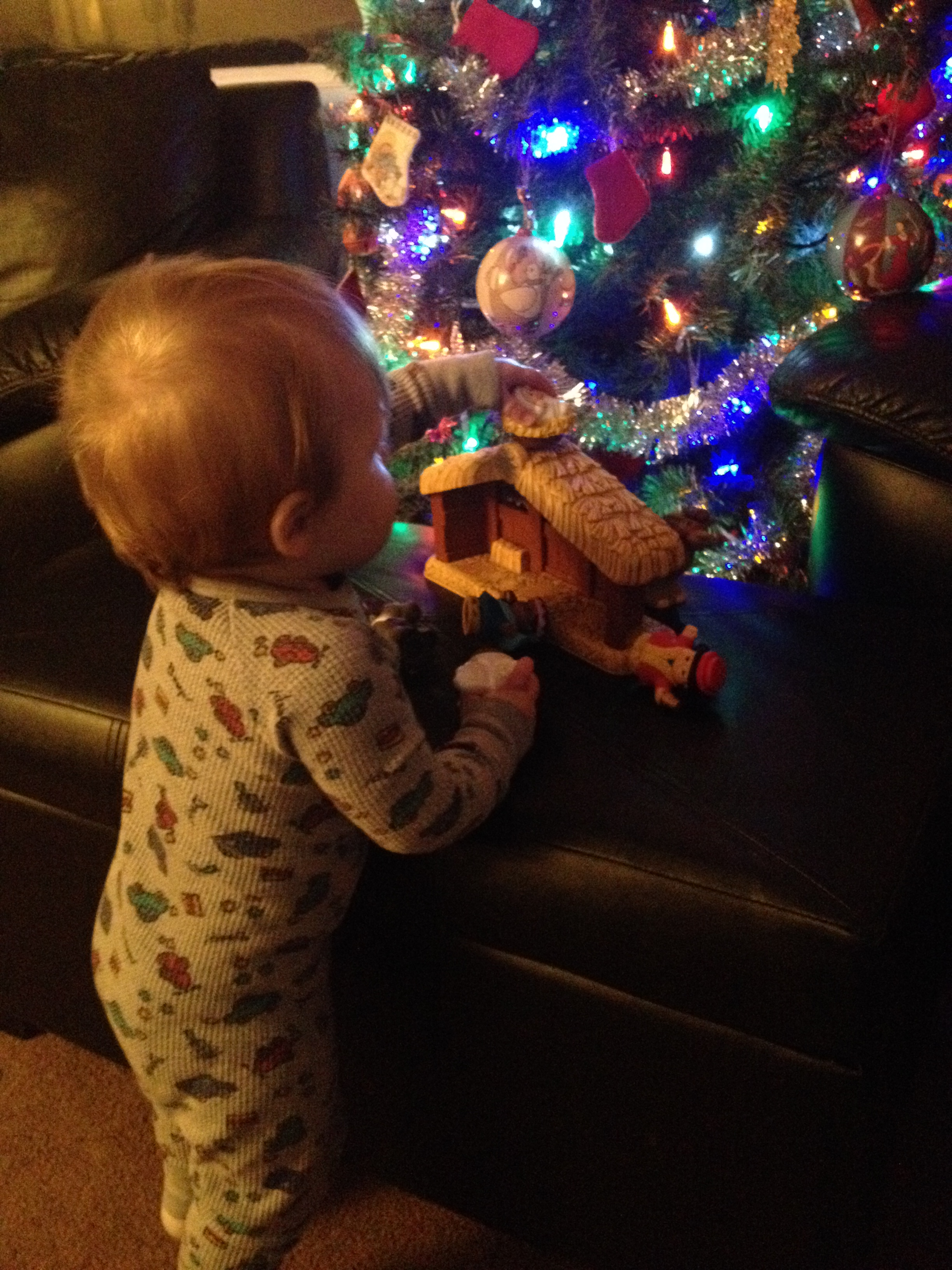
Last week, we pulled out that same bargain tree and began decorating it again. This is the 12th time we have decorated our silly tree, and each year we continue to dream about the day when we can justify purchasing a new one. This year we laughed extra hard as we traumatized our poor two-year old with this “pretend tree” that we pulled out of its box and began to assemble. Though he was skeptical at first, as he “helped” us assemble the tree, his appreciation for the tree appeared to grow as his excitement for Christmas swelled. He sat by the tree with his little brother sharing, in the way that only a two-year old can, about all of the wonders that this tree would soon hold.

He bounced all over the living room as we placed our star on the top of the tree. I had wanted to buy a new one because I knew the “star on top” was a big deal to his two-year-old heart, but we couldn’t afford one this year and he quickly accepted our old, tacky topper as the perfect star for the top. I gratefully acknowledged that Keilan’s excitement for Christmas allowed him to overlook the flaws of our “tend tree;” even while his dad and I tried to strategically place lights and ornaments to create the illusion of a full, verdurous tree.

A few days after putting up our tree, I noticed that the giant Christmas tree was lit in front of the shopping mall near our home, and I suggested that we drive by to give Keilan a thrill. We were not disappointed in our son’s reaction; his giggles and shouting showed his wonder at the brilliance and height of the tree. And as I turned around to catch his expression, I asked, “Isn’t it beautiful?!?”
I, myself, was impressed by the beauty and height of the tree, and I was shocked by his answer: “No, mom. The big, mall tree is not my favorite tree.”
“It’s not?” I asked, while scanning the other tress that twinkled around the tall center tree, “Which tree is your favorite?”
“My beautiful star tree. The tree at Kei’s house.” was his earnest reply. And I, once again, was challenged by the power of perception. That old tree of ours is no longer just a silly, cheap tree. Patrick and I were wrong; that tree has great value because it is “ours.” A few tears caught in my throat as I heard the sweetness of his voice and considered his thoughtful answer. What a relief that the best we had to offer was the stuff his Christmas dreams were made of; for him, our tree was perfection, and it was his “favorite.”
How often do we hesitate to offer what we have because we assume that it can’t possibly be enough? And how powerful would it be if we could only keep reminding ourselves of how often our perceptions are “wrong.” And maybe when a situation feels a bit hopeless or things are starting to feel “off-task,” we need to remember that we are only seeing things with a limited perception: our own. So, today I will find joy in my journey by accepting that very often my perceptions are “wrong” and by choosing to accept the perception of “hope” instead.
“May the God of hope fill you with all joy and peace as you trust in him, so that you may overflow with hope by the power of the Holy Spirit.” Romans 15:13

“May the God of hope fill you with all joy and peace as you trust in him, so that you may overflow with hope by the power of the Holy Spirit.” Romans 15:13
Please feel free to share!











 Finding Joy in My Journey